
GV14 Da Zhui (大椎) Dog Acupuncture Point
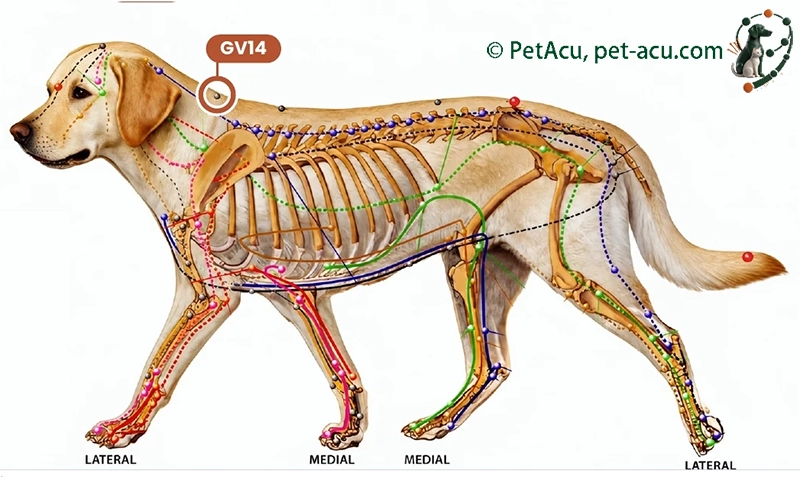
In dogs, GV14 (Da Zhui, 大椎) is a point on the Governing Vessel meridian. Location: In a depression on the dorsal midline, between the seventh cervical and the first thoracic vertebrae. Traditional indications in this chart include neck problems, disorders of the cervical spine, occipital neuralgias.
This page is educational. It describes a point in dogs as listed in traditional charts and does not give treatment advice. Points should be needled only by trained veterinary professionals. See our Medical Disclaimer.
Quick facts
- Species
- Dog
- Point code
- GV14
- Pinyin
- Da Zhui
- Chinese name
- 大椎
- Meridian
- Governing Vessel
- Element or system
- Sea of Yang meridians
- Point category and notes
- Meeting of all Yang meridians; Key antipyretic point
Where is GV14 Da Zhui on a dog?
In a depression on the dorsal midline, between the seventh cervical and the first thoracic vertebrae.
Point locations are approximate and vary with breed and body size. A trained practitioner finds the point by feeling anatomical landmarks.
Want GV14 Da Zhui on a chart you can keep? Our printable dog meridian chart and cards are an instant download you can print or edit for study notes and clinic handouts.
Traditional indications
- Neck problems
- disorders of the cervical spine
- occipital neuralgias
- infectious diseases with rhythmic occurrence
- respiratory tract problems
- asthma
- cough
- cold
- fever
- heat stroke
- chills
- brain
- eczema
- lack of energy
- epilepsy
Indications are taken from traditional veterinary acupuncture charts. They describe how the point has been used and are not proof that it treats these conditions in dogs.
Dog conditions that mention GV14 Da Zhui
PetAcu dog condition guides that name this point:
Points often discussed alongside GV14 Da Zhui
These points appear in the same dog condition guides. A practitioner chooses a combination for each dog.
See these points together on a downloadable dog acupuncture chart with English and Chinese names, available as a digital download from PetAcu.
Safety notes
Needling should only be done by a trained veterinary professional. This point lies on or beside the spine, so depth and angle must account for the spinal cord and vertebral canal, particularly in dogs with spinal disease.
Some owners are shown gentle acupressure by their veterinarian. Do not press on a painful area, and stop if your dog shows pain, guarding or anxiety. If your dog suddenly cannot walk or is in severe pain, see a veterinarian immediately.
Questions about GV14 Da Zhui
Where is GV14 Da Zhui on a dog?
In a depression on the dorsal midline, between the seventh cervical and the first thoracic vertebrae. Locations are approximate and are found by palpation by a trained practitioner.
What is GV14 Da Zhui used for in veterinary acupuncture?
The source chart lists neck problems, disorders of the cervical spine, occipital neuralgias, infectious diseases with rhythmic occurrence, respiratory tract problems, asthma, cough, cold and others as traditional indications. This is traditional use and not proof of effect.
Can I use GV14 Da Zhui at home?
Needling should only be done by a trained veterinary professional. Gentle acupressure is sometimes shown by veterinarians, so ask yours first, especially if your dog is in pain, has a spinal problem or has not been examined.
Is there a printable or downloadable dog acupuncture point chart?
Yes. PetAcu offers a printable dog acupuncture point chart and illustrated point cards as an instant digital download, with English and Chinese names, so points such as GV14 Da Zhui are easy to find again. Editable files are available for study notes and clinic handouts. See the printable dog acupuncture point cards or browse PetAcu digital products. A chart is a learning and reference aid, not a treatment plan.
Learn more and next steps
Printable dog acupuncture point cards
Illustrated cards showing common dog points, with English and Chinese names and Five Element colour coding. Instant download on Gumroad.
Get the cards on Gumroad →Find a veterinary acupuncturist
Browse clinics and mobile vets by country, state and city.
Search the directory →PetAcu digital products
Original PetAcu charts and reference materials for students, veterinary professionals and curious owners, with more species and clinic materials in preparation.
See all digital products →Some resources are our own digital products, sold on Gumroad. Links to products from other makers may be affiliate links and are labelled. See our Affiliate and Product Disclosure.
Other Governing Vessel points with guides
Species: dog. Point data compiled by PetAcu from Acupuncture for Dogs and Cats: A Pocket Atlas (Eul-Matern, Thieme, 2nd edition, 2022). Back to the dog acupuncture points chart or the veterinary acupuncture points atlas. Looking for a downloadable version? Get the dog acupuncture chart and point cards or other PetAcu digital charts.