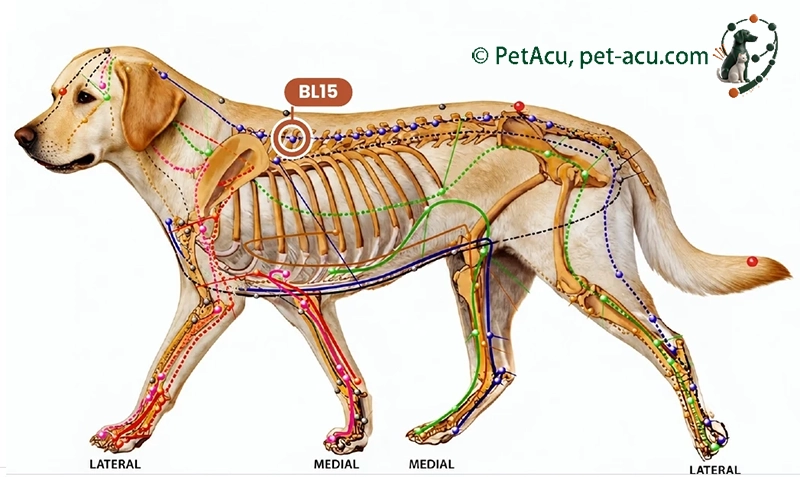
BL15 Xinshu Dog Acupuncture Point
Xīn Shū 心俞Professional veterinary acupuncture overview of BL15 Xinshu in dogs, including anatomical location, cardiac, neurological and behavioural support applications, classical functions, point pairings, and safety notes.
| Chinese Name | 心俞 |
| Pinyin | Xīn Shū |
| Meridian | Bladder Meridian (BL) |
| Anatomical Location | 1.5 cun lateral to GV11, below the spinous process of T5. (第5胸椎旁开1.5寸) |
| Main Indications | Cardiac disorders, epilepsy, insomnia, palpitations, anxiety, chest pain, poor memory, night sweating, manic behaviour. |
| Classical Function | Back-Shu of Heart; calms the Shen, regulates Heart Qi and Blood, clears Heart Fire, nourishes Heart Yin, and supports cardiac and neurological function. |
| Meridian Color | 膀胱经 | Bladder Meridian | Water | Black / Deep Blue |
Clinical Overview
BL15 is one of the most clinically significant back-shu points in the thoracic region. As the Back-Shu of the Heart, it holds a direct classical connection to Heart organ function across both physical and mental-emotional dimensions. In TCVM, the Heart governs the blood, houses the Shen (spirit or mind), and has broad influence over consciousness, sleep, and emotional regulation — all of which make BL15 a remarkably wide-ranging point in veterinary practice.
TCVM practitioners incorporate BL15 into protocols for dogs presenting with cardiac arrhythmias, seizure disorders, restlessness, anxiety, and sleep disturbances. The point can be needled with reducing technique to clear Heart Fire or Excess patterns, or with tonifying technique and moxibustion to nourish Heart Yin and Blood in deficiency presentations.
Veterinary Disclaimer
This educational content is not intended to replace professional veterinary diagnosis or treatment. Acupuncture and electroacupuncture should only be performed by a licensed veterinarian or certified veterinary acupuncturist.
BL15 Canine Acupuncture Point Placeholder
Use this area for the canine BL15 anatomical map or your future TCVM illustration. BL15 lies one vertebral level below BL14 (T4) and one level above BL16 (T6) along the inner Bladder line.
Pinpoint Location
Anatomical Landmark
Locate the fifth thoracic vertebra (T5) by counting two spinous processes caudal from T3 (the landmark for BL13). Measure 1.5 cun laterally from the lower border of the T5 spinous process. BL15 sits directly below BL14 (T4 level) and directly above BL16 (T6 level) along the medial branch of the inner Bladder line. BL44 (Shentang) is located at the same vertebral level but on the lateral branch, 3 cun from the midline.
Needling Direction & Depth
Oblique needling directed toward the spine at 0.5–0.8 cun is the standard approach. Alternatively, transverse needling of 1.0–1.5 cun toward the spine may be applied. Perpendicular deep needling must be avoided at this location due to the risk of pneumothorax. Extra caution is warranted in lean or small-breed dogs where intercostal spaces are shallow. Moxibustion is applicable and commonly used for deficiency patterns.
Primary Clinical Indications
BL15 addresses both structural cardiac conditions and the wide range of Shen-related disturbances governed by the Heart in TCVM:
- Cardiac Disorders: Referenced for palpitations, arrhythmia, cardiac pain, and chest fullness due to Blood Stagnation or Heart Qi deficiency. Classical sources including the Zhenjiu Jiayijing (Systematic Classic of Acupuncture and Moxibustion) formally documented BL15 for cardiac pain and related conditions.
- Epilepsy & Seizure Disorders: Included in TCVM protocols for dogs with epilepsy and manic or convulsive presentations. The point's ability to calm the Shen and clear Heart Fire underpins its neurological applications.
- Insomnia & Restlessness: One of the primary points for sleep disturbance and agitation associated with Heart Fire, Heart Empty Heat, or Heart Yin Deficiency. In canine patients this may present as night-time restlessness, vocalisation, or inability to settle.
- Anxiety & Emotional Disturbance: Used for weeping, fright, excessive fear, and manic or depressive states related to Heart Shen disharmony. Reducing technique is applied for Excess patterns.
- Poor Memory & Mental Confusion: Referenced for cognitive presentations associated with Heart Yin Deficiency, including disorientation and loss of memory. Tonifying technique or moxibustion is appropriate for these deficiency patterns.
- Night Sweating & Cough: Classically documented alongside cardiac and Shen-related indications in major acupuncture texts including A Manual of Acupuncture.
Recommended Point Pairings
BL15 is one of the most frequently paired thoracic back-shu points in clinical TCVM, with well-established combinations across cardiac, neurological, and behavioural protocols.
BL15 + CV14 (Juque): The classical Back-Shu/Front-Mu pairing for direct Heart organ treatment. This combination is one of the most foundational pairings in TCVM for cardiac disorders, chest pain, and palpitations. Research in the TCVM literature shows BL15 + CV17 improved myocardial ischemia markers, supporting this pairing's cardiovascular applications.
BL15 + HT7 (Shenmen): One of the most important combinations in classical acupuncture for insomnia, anxiety, and cardiac disorders. BL15 as Back-Shu of the Heart combined with HT7 as the Yuan-Source point of the Heart channel creates a powerful pairing that directly regulates Heart Qi, Blood, and Shen.
BL15 + BL14 (Jueyinshu) + PC6 (Neiguan) + HT7 (Shenmen): A frequently referenced multi-point protocol for palpitations, arrhythmia, chest pain, and anxiety. Addresses both the Heart and Pericardium through their respective Back-Shu points combined with calming distal points on the Heart and Pericardium channels.
BL15 + GV14 + GV20 + PC6: Commonly incorporated into TCVM protocols for dogs with epilepsy. BL15 contributes Shen-calming and Heart Fire-clearing actions, while GV points address the governing vessel and brain, and PC6 regulates the Pericardium and calms the nervous system.
BL15 + HT7 + SP6 + KD3: A broad Shen-calming and Yin-nourishing combination for restlessness, anxiety, and insomnia presentations in dogs. SP6 and KD3 support Yin deficiency underlying patterns that contribute to Heart Shen disturbance.
BL13 (Feishu) + BL14 (Jueyinshu) + BL15: All three adjacent thoracic back-shu points combined for comprehensive upper thoracic support where lung, pericardium, and heart functions require coordinated treatment within a single protocol.
Modern Veterinary Interpretation
From a modern integrative veterinary perspective, BL15 is positioned near the fifth thoracic vertebra, a region associated with autonomic innervation of the heart, lungs, and great vessels. Needle stimulation at this location may modulate sympathetic and parasympathetic tone influencing cardiac rhythm and stress responses.
In dogs with idiopathic epilepsy, integrative veterinarians may incorporate BL15 into multimodal management plans alongside conventional antiepileptic therapy, given the point's classical role in calming neurological and Shen-related disturbances. For dogs with behavioural anxiety or stress-induced cardiac arrhythmias, BL15 may be part of broader electroacupuncture and rehabilitation protocols.
Safety & Needling Notes
Professional Veterinary Use Only
BL15 lies over the thoracic cage adjacent to the lungs. Deep or perpendicular needling carries a risk of pneumothorax and must be avoided. Only trained veterinary acupuncturists should needle this point, using oblique or transverse technique directed toward the spine. Depth should be calibrated carefully to the individual patient's size and body condition, with particular caution in thin or small-breed dogs.
Cardiac & Epileptic Patients — Special Consideration
In dogs with known cardiac disease or active seizure disorders, acupuncture protocols including BL15 should be designed and supervised by a veterinarian familiar with the patient's full medical history. Electroacupuncture parameters should be adjusted conservatively, and treatment sessions should be carefully monitored for patient response.
Gentle Acupressure Guidance
Pet owners exploring supportive acupressure at the BL15 region should apply only gentle fingertip pressure. Discontinue immediately if the dog shows signs of discomfort, stress, or worsening symptoms. Acupressure is not a substitute for veterinary diagnosis or treatment.
Editorial & Veterinary Review
This educational resource was prepared by the PetAcu editorial team using veterinary acupuncture references, TCVM educational materials, canine rehabilitation resources, and integrative veterinary literature — including the Zhenjiu Jiayijing (Systematic Classic of Acupuncture and Moxibustion), A Manual of Acupuncture, Me & Qi acupuncture databases, and peer-reviewed research on BL15 in cardiac and neurological protocols.
Canine Acupuncture Atlas
Browse the complete veterinary acupuncture point database for dogs.
Explore Atlas →Dog Conditions That Acupuncture Treats Well
Explore integrative TCVM and acupuncture resources for dogs.
View dog conditions →Find a Veterinary Acupuncturist
Discover integrative veterinary practitioners and rehabilitation clinics.
Browse directory →DOWNLOAD FULL ATLAS
Explore professional canine acupuncture charts, rehabilitation-oriented acupoint references, and TCVM educational resources designed for pet owners and veterinary professionals.
DOWNLOAD FULL ATLAS